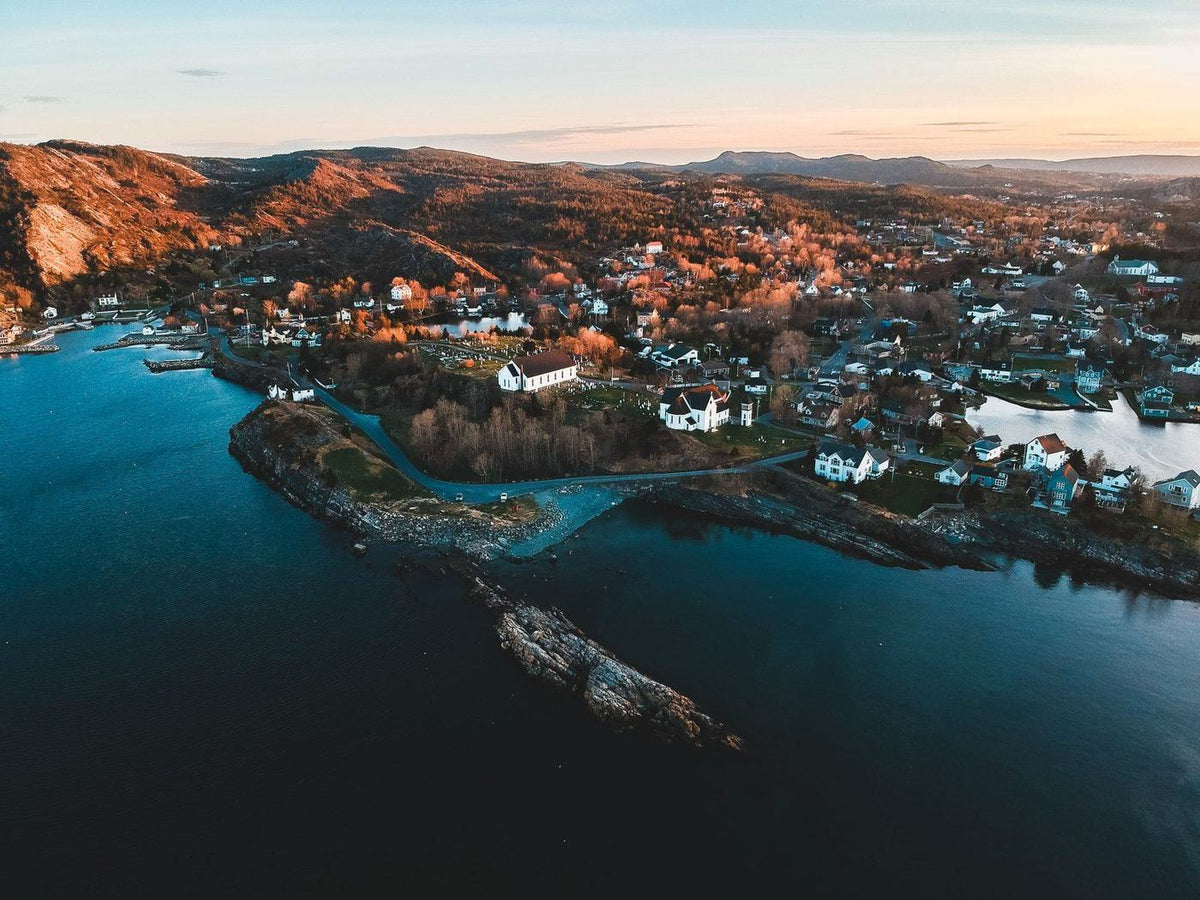
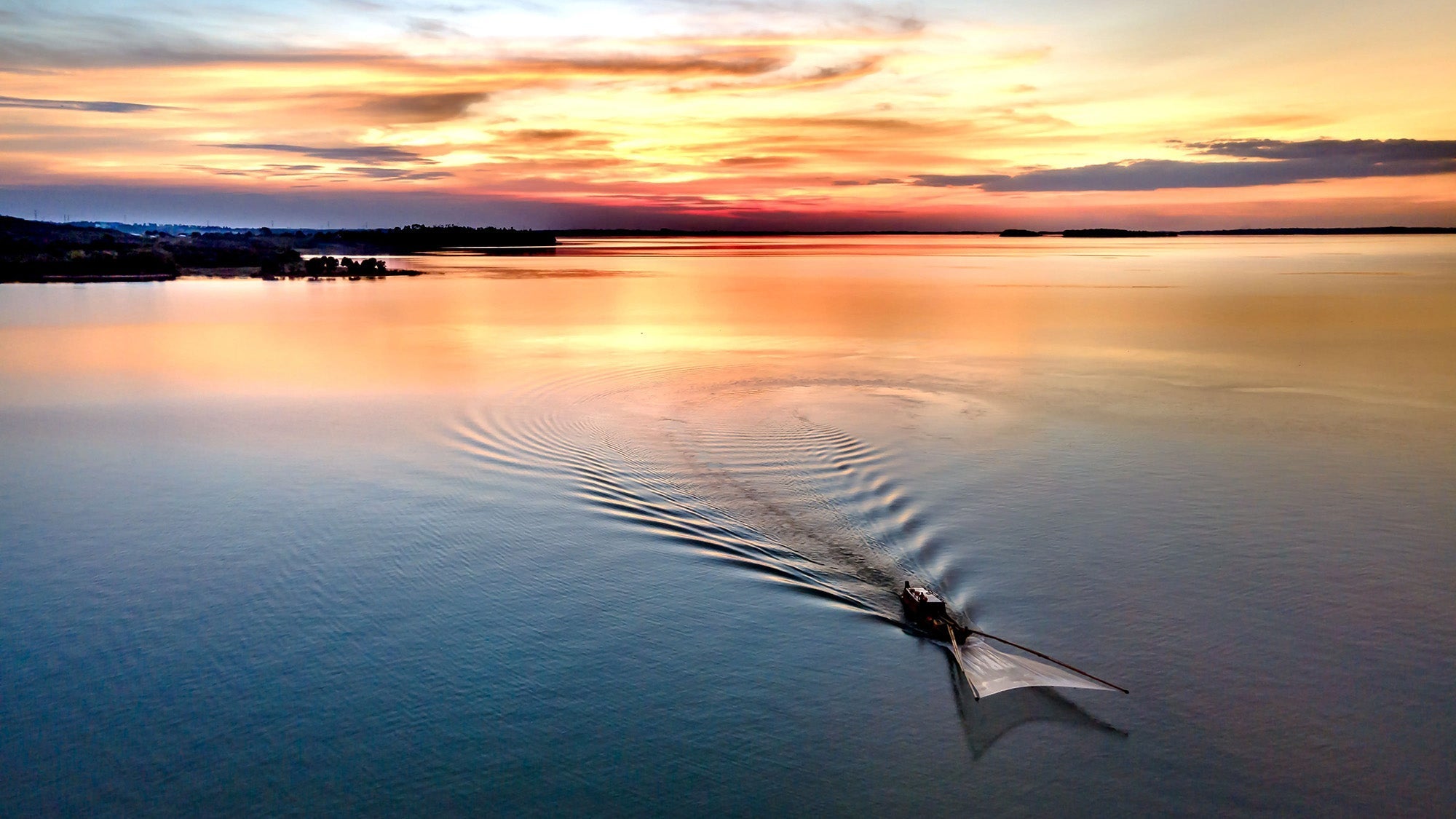

You won’t capture the best, legal sunset photo with your drone during sunset itself, but rather up to about 15 minutes after the official sunset. During this time window, the sky takes on soft colors, and land and water are dark but still visible. A drone sensor can’t handle the contrast between a bright sun and a shadowed foreground, so your timing determines whether your photo will be warm and layered or a flat silhouette without detail.
This guide explains why sunset photography is challenging, which time window to choose, what settings to use for each situation, and how to use composition to carry the scene.
Why sunset photography is challenging for a drone
A sunset has a dynamic range of 15 stops or more. In practice, a drone sensor (Mini 5 Pro, Air 3S, Mavic 4 Pro) can capture 11 to 13 stops. That difference is what you notice when the sky looks stunning but the land in your photo turns pitch black, or when the water glistens but the sun appears completely white and lacks texture.
On top of that, drones are at a disadvantage at the most crucial moment: when the sky is at its most beautiful, it also gets dark quickly. Lighter drones struggle with gusts of wind over the coast in the evening. In the Netherlands, for example, the golden hour lasts only 35 minutes in December, but more than 90 minutes in June.
The Best Time Window: Golden Hour, Magic Hour, and Blue Hour
|
Phase |
Time window |
What you get |
|
Late golden hour |
30 to 10 minutes before sunset |
Warm side light, long shadows, high contrast. Great for textured landscapes. |
|
Magic hour (around sunset) |
10 minutes before to 10 minutes after |
A golden sky transitioning to red and magenta. Low sun, strong reflections on water. This is the hour for that iconic photo. |
|
Early blue hour |
up to 15 min after |
Blue-violet sky with lingering glow in the west. City lights come on. Softer contrast, wider dynamic range. |
|
Late blue hour |
30 to 50 minutes after |
Deep blue, very little light. With a drone, this is only interesting in urban environments (light trails, building facades). Shutter speeds get so long here that you need a windless evening. |
Plan with Drone Class Plus. With the pre-flight planner from Drone Class Plus, you can see all weather information at a glance. Enter your location and immediately see what time the golden hour and blue hour are today.

¿No sabes qué licencia necesitas?
Composition Tips for Sunset
Don’t place the sun in the center. The eye is automatically drawn to the brightest point. If you do that, the image won’t settle until the second person looks at it. Place the sun on a third line, or leave it just outside the frame so that only the light is visible.
Work with reflections. Water, wet stretches of sand, or glass double the impact of the sky. A bay at high tide with a calm, mirror-like sea is the easiest way to succeed in sunset photography.
Use shadows as a compositional element. A high sun produces flat photos; a low sun creates shadows that are just as important as the subject. A row of trees, a dike, a row of windmills: during golden hour, they become long, graphic lines that cut through your image.
Fly higher, not lower. At sunset, the ground is the least cooperative part of your photo. A higher flying altitude (80 to 100m) captures more sky and more reflection in the frame.
Top-down shots work especially well now. Because the sun is low, surfaces and water create a gradient: light brown/gold on the sunlit side, blue-gray on the other side. Capturing that gradient in a single top-down frame is exactly what a photographer on foot could never achieve.
Three Common Mistakes
1. Taking off too late. The best light is gone before you’ve even paired your drone. Arrive at the location an hour early and do a test flight.
2. Forgetting to switch to manual mode. In Auto mode, the drone readjusts the exposure every 5 seconds, so a series of shots will have different color temperatures. Set your camera settings to Manual.
3. Not using RAW format. At sunset, the color temperature shifts by the minute. With RAW (DNG), your files contain more information, allowing you to correct colors in post-processing.
Drone regulations for sunset and evening flights
Flying a drone during sunrise and sunset (in the Netherlands, 15 minutes before or after) is permitted. Night flights are prohibited in the Netherlands. For blue hour photography, you can fly, but plan your flight so that you land no later than 15 minutes after sunset.
Always fly within visual line of sight (VLOS). In twilight, your drone will disappear from view more quickly. Position your drone at a distance where you can still see it clearly, and use the DJI signal LED or an external add-on LED light. Always check the drone map before the flight.
Night flights abroad. According to EASA regulations, night flights are permitted (provided lighting requirements are met). In many European countries, it is possible to fly a drone at night. Check the country’s regulations to determine whether night flights are prohibited by local laws.
EU Drone License. Want to know where you can and cannot fly a drone? In the training course for the EU Drone License you’ll learn all the European drone regulations. That way, you can be sure your drone flights are always legal.
Frequently Asked Questions
What’s the best time to photograph a sunset with a drone?
Between 30 minutes before and 30 minutes after the official sunset. The most beautiful moment is the ten minutes immediately around sunset, followed by the first ten minutes afterward.
Can I still fly a drone after sunset?
Yes, in the Netherlands, up to 15 minutes after sunset in the open category.
What’s the best composition for a drone sunset shot?
A top-down shot from 80 to 100 meters provides a unique perspective. Place reflective water or wet sand prominently in the frame. Don’t place the sun in the center—position it on a third line, or leave it just outside the frame. Use long shadows cast by objects as compositional elements.

Learn the technique behind sunset photography
A good sunset photo taken with a drone is a combination of timing, settings, and composition. These elements of photography are covered in Drone Class Plus.
Plus offers comprehensive guides on how to set up your drone camera, composition techniques, and drone photos from other drone pilots, complete with settings and locations.