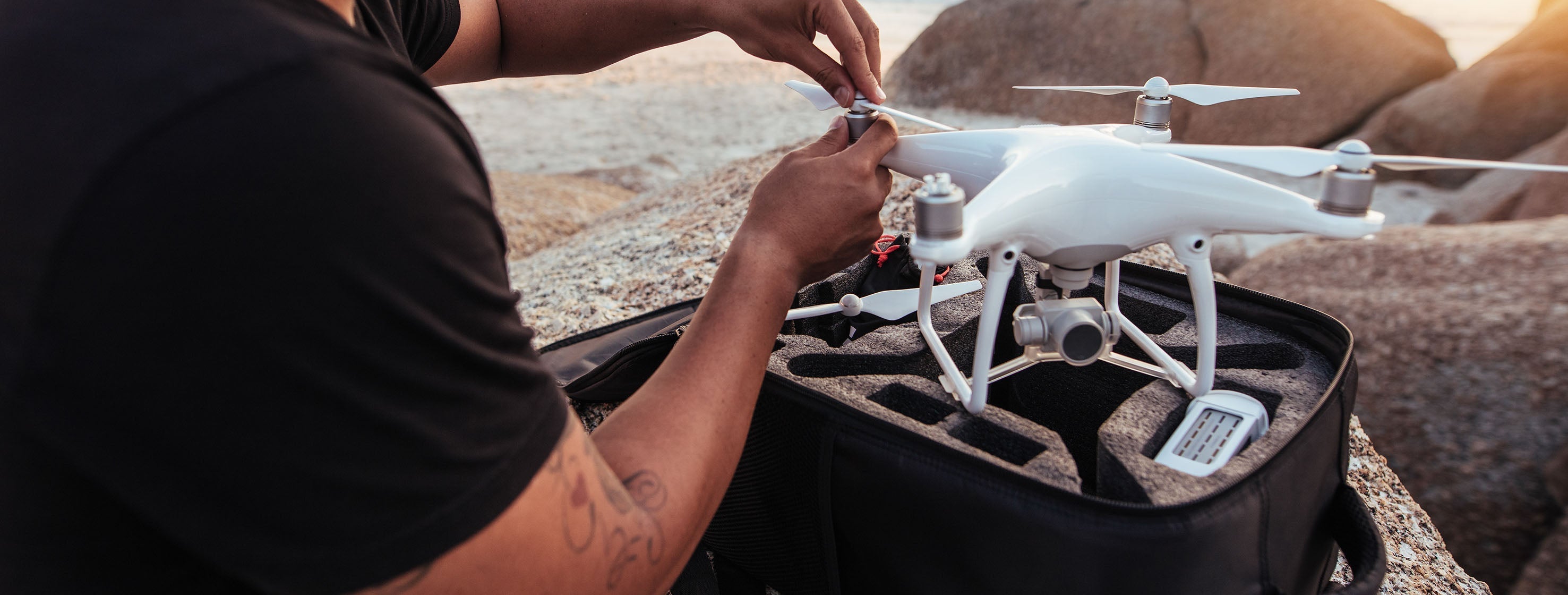

A drone in your backpack will transform your travel photos. Suddenly, you can see those rice fields in Bali from above, capture an empty beach at sunrise, or film yourself driving along a coastal road in Italy. But which drone should you bring? We’ve listed four that are truly worth taking on your travels: the DJI Mini 5 Pro, the DJI Air 3S, the DJI Avata 360, and the DJI Mavic 4 Pro.
Drone regulations while traveling
The same EASA regulations apply throughout the EU. Your EU Drone License and operator number are therefore valid throughout the EU. Additional national drone rules may apply. Therefore, always check the drone regulations of the country you are traveling to before departure.
Don’t have the EU Drone License yet? You can obtain this certificate online within a day. Read all the information about the EU Drone License here
Outside the EU, European drone regulations do not apply. Each country has its own legislation regarding drones. Sometimes you must register in advance or apply for a permit. In some countries, drones are completely banned. Always check this before you leave.
Best drones for traveling abroad
First, a brief overview of the drones mentioned in this blog:
|
DJI Air 3S |
Best all-around drones, compact, excellent camera, and smart flight features |
|
DJI Mini 5 Pro |
Great entry-level drone, all the features a beginner needs, lightweight and compact |
|
DJI Mavic 4 Pro |
Professional footage, powerful recording quality |
|
DJI Avata 360 |
For 360 FPV footage, all necessary flight functions |

DJI Mini 5 Pro - Fits in any backpack
The DJI Mini 5 Pro fits in any backpack or suitcase. Thanks to its light weight and small size, this drone is easy to take with you.
The DJI Mini 5 Pro features a 1-inch sensor and delivers 4K/60fps HDR video. It also includes omnidirectional obstacle sensing with forward-facing LiDAR, a 225° rotating gimbal for vertical shots, and ActiveTrack 360°. The battery provides approximately 36 minutes of flight time.
The DJI Mini 5 Pro is ideal for city trips, backpackers, vloggers, and vacationers looking for a device that lets them capture great footage.
Key specifications
- Lightweight and compact design
- 1" sensor with a maximum video quality of 4K/120 fps
- Med-Tele Mode (48 mm digital)
- Vertical recording via gimbal rotation
- LIDAR sensors
- ActiveTrack
- 52 minutes of flight time
An overview for consideration:
|
Pros |
Disadvantages |
|
Very compact and lightweight |
Smaller sensor |

Not sure which license you need?
DJI Air 3S - The all-rounder with dual cameras
If you want better image quality than the Mini offers, the Air 3S is an excellent step up. The DJI Air 3S features a dual-camera system with a 1-inch wide-angle (24mm, 50MP) and a 70mm medium telephoto (48MP, 1/1.3-inch) . That telephoto lens is exactly what you often miss when traveling; you can suddenly capture someone on a distant mountaintop or spot animals without disturbing them. Both cameras shoot 4K/60fps HDR with 14 stops of dynamic range.
The drone offers 45 minutes of flight time per battery, 20 km O4 transmission, omnidirectional obstacle sensing with LiDAR, and 42 GB of internal storage—handy when your SD card is full. It’s no surprise that the Air 3S has been hailed as the ultimate travel drone for content creators worldwide.
The drone is suitable for travelers who want to create serious content, vloggers who want the extra zoom, and pilots who want to make the leap to pro-quality without carrying a Mavic.
Key specifications
- Main camera 1" CMOS (50 MP)
- Zoom lens 1 1/3" CMOS (48 MP)
- Video resolution 4K (120 fps)
- Obstacle sensors (and front-facing LIDAR detection)
- DJI RC Track (tracking beacon)
- Long flight time (up to approx. 45 minutes)
- ActiveTrack, timelapse, hyperlapse, and QuickShots
An overview to consider:
|
Pros |
Cons |
|
Very versatile |
No ultra-wide angle like on the Pro models |

![]() DJI Avata 360 - For unique perspectives
DJI Avata 360 - For unique perspectives
The Avata 360 is DJI’s first 360° drone and also an FPV drone. With two cameras (each 1/1.1-inch, 64MP), you can film the entire world around your drone in 8K/60fps. During editing, you decide afterward which direction the camera is facing—fly first, frame later. Or switch to Single Lens mode for classic FPV shots in 4K/60fps.
If you want to capture creative footage while traveling and fly your drone freestyle—for example, footage where you fly close to cliffs at high speed and from various angles—then this is the best drone on the market.
You can control the DJI Avata 360 with the RC 2 (standard controller) or with the Motion Controller 3. The drone is compatible with the DJI Goggles 3 and the DJI Goggles N3. This drone has a flight time of about 23 minutes per battery.
This drone is ideal for content creators who want out-of-the-box footage that standard drones can’t capture.
Key specifications
-
360° system with 8K/60 fps video and 4K/60 fps in Single Lens mode
-
Dual 1/1.1-inch camera sensor (64MP per lens)
-
Spotlight Free, ActiveTrack 360°, and Virtual Gimbal for dynamic shots without complicated controls
-
Built-in propeller protection (cinewhoop design)
-
Omnidirectional obstacle sensing with forward-facing LiDAR
-
Compatible with DJI Goggles N3 + Motion Controller 3 and DJI RC 2
An overview for consideration:
|
Pros |
Cons |
|
360° footage—fly first, frame later |
FPV flying requires some practice |

DJI Mavic 4 Pro - The best image quality
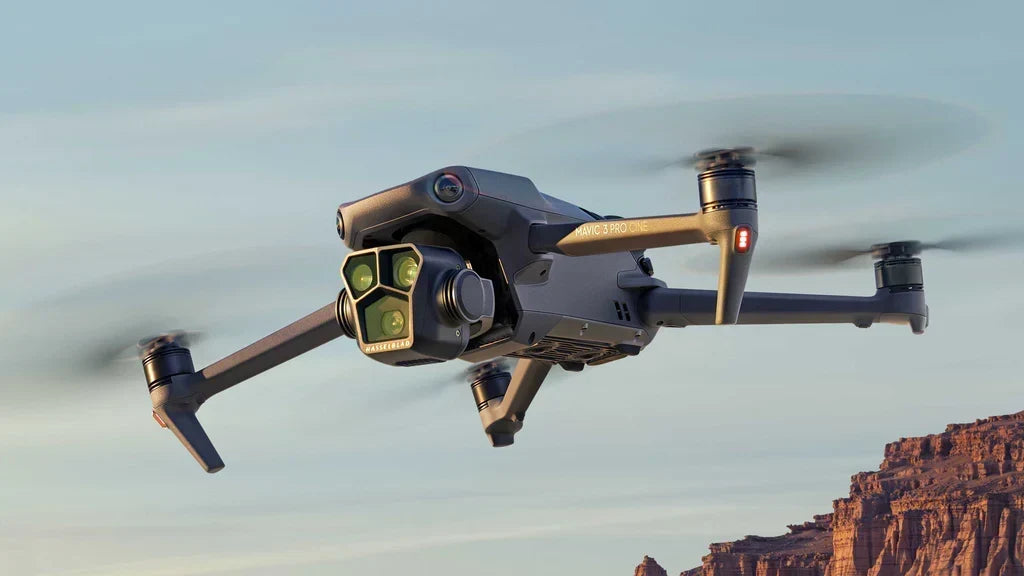
The DJI Mavic 4 Pro is the drone with the best image quality on this list. The drone is a bit heavier than the other models, making it less portable; it weighs 1063 grams.
If you choose this drone, the image quality is stunning. It features a triple camera system with a 100MP Hasselblad 4/3 sensor (6K/60fps HDR), plus a 48MP medium telephoto and a 50MP standard telephoto lens. The new 360° Infinity Gimbal can rotate from -40° to 400° while filming—making impossible camera movements suddenly possible. It also offers 51 minutes of flight time, a 30 km transmission range, and omnidirectional obstacle sensing with LiDAR that works down to 0.1 lux.
This drone is suitable for professional filmmakers and photographers who want the highest image quality.
Key specifications
- Triple camera module
- Hasselblad main camera (100 MP) (4/3-inch CMOS sensor)
- Two telephoto lenses
- Revolutionary 360° Infinity Gimbal
- High-quality video recording
- Long flight time (up to approx. 51 minutes)
- ActiveTrack, timelapse, hyperlapse, and QuickShots
An overview for consideration:
|
Pros |
Disadvantages |
|
Triple camera module |
High purchase price |
Which travel drone is best for you?
The drone world continues to evolve. Even in 2026, new flight features, higher-quality cameras, and updated safety features will continue to be added to new drones.
Which drone is best for you depends on your needs. Are you a beginner or an advanced pilot? Do you plan to travel a lot, or do you want to capture truly high-quality content? Not sure which drone is best for you? Feel free to contact us. We’re happy to help.