
On Wednesday 12 August 2026 a solar eclipse sweeps across Europe. It is total over western Iceland and northern Spain, and partial everywhere else, with 80% to 95% of the sun covered depending on where you are. It is the first total solar eclipse in Europe since 1999, and with your drone you capture it very differently than with an ordinary camera. In this guide you get seven concrete tips for coming home with unique footage, safely and within the rules.
When can you see the solar eclipse?
|
Date |
Wednesday 12 August 2026 |
|
Start (Europe) |
Between roughly 17:00 and 17:40 UTC (19:00–19:40 CEST), a few minutes’ difference per location |
|
Maximum |
Between roughly 17:50 and 18:40 UTC (19:50–20:40 CEST). Total in western Iceland and northern Spain, 80% to 95% covered across the rest of Europe |
|
End |
Around 18:45 to 19:30 UTC, but across much of central, eastern and southern Europe the sun sets before the eclipse ends |
|
Height in the sky |
Low: at maximum the sun stands about 15 degrees above the horizon in Ireland, some 7 degrees over France and the Benelux, and right on the horizon in south-eastern Europe |
That low position is the single most important fact for drone pilots. The sun sits just above the horizon and goes down during or shortly after the eclipse. That means little light, long shadows, and a sun you can only get in frame by shooting flat towards the western horizon, so you need a clear view in that direction.
Below you will find seven concrete tips for getting the most out of your drone, safely and within the rules. The first two are about safety, the rest about the photography itself.
Tip 1: Do not point the camera straight at the sun for long, protect your sensor
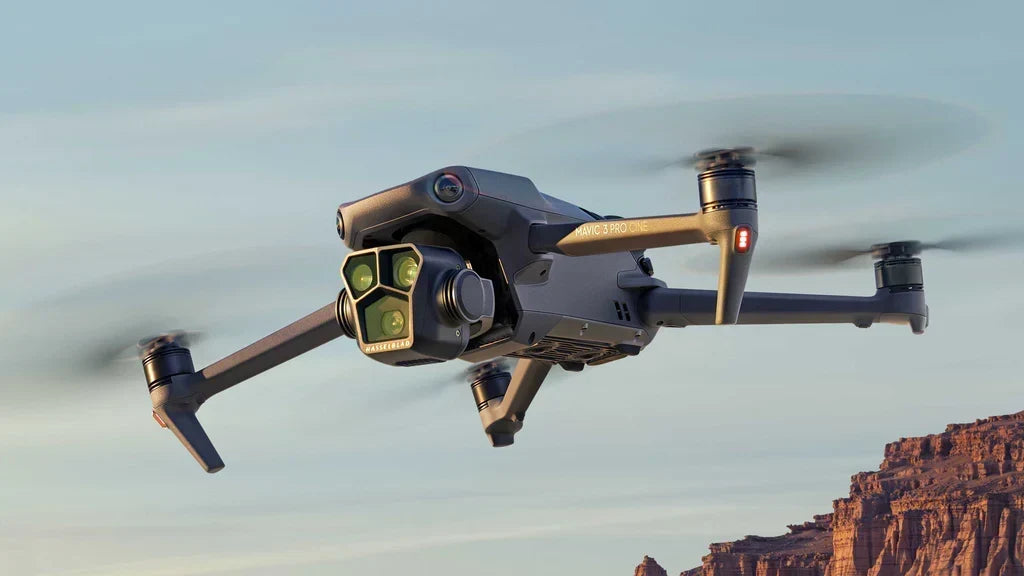
Filming straight into the (partly eclipsed) sun for a long time can permanently damage the image sensor: burnt-out pixels that never recover. On several recent drones DJI itself explicitly warns against pointing the camera at strong light sources such as the sun for extended periods.
And this is exactly where a drone differs from an ordinary camera. On a system camera you screw a dedicated solar filter in front of the lens. A normal ND filter (grey filter) is not a solar filter. It dims the light, but does not block enough of the harmful radiation. With a drone there is only one safe route: do not keep the camera pointed straight at the sun.
Não sabe qual a licença de que precisa?
Tip 2: Stick to the flight rules at dusk
The eclipse falls in the last hour before sunset. You must be able to see your drone clearly at all times (VLOS). During an eclipse it gets noticeably darker while the sun is already low, so keep your drone extra close.
• Check the map.The eclipse changes nothing about where you are allowed to fly. Open the drone map for your country.
• Avoid crowds.Popular viewing spots such as headlands, hilltops, dikes and observatories draw a public. Flying over that crowd is not allowed, however tempting the overview may be.
• Keep your distance from other watchers.A buzzing drone ruins the moment for anyone staring up through eclipse glasses. Pick a quiet spot.

Tip 3: Decide in advance which shots you want
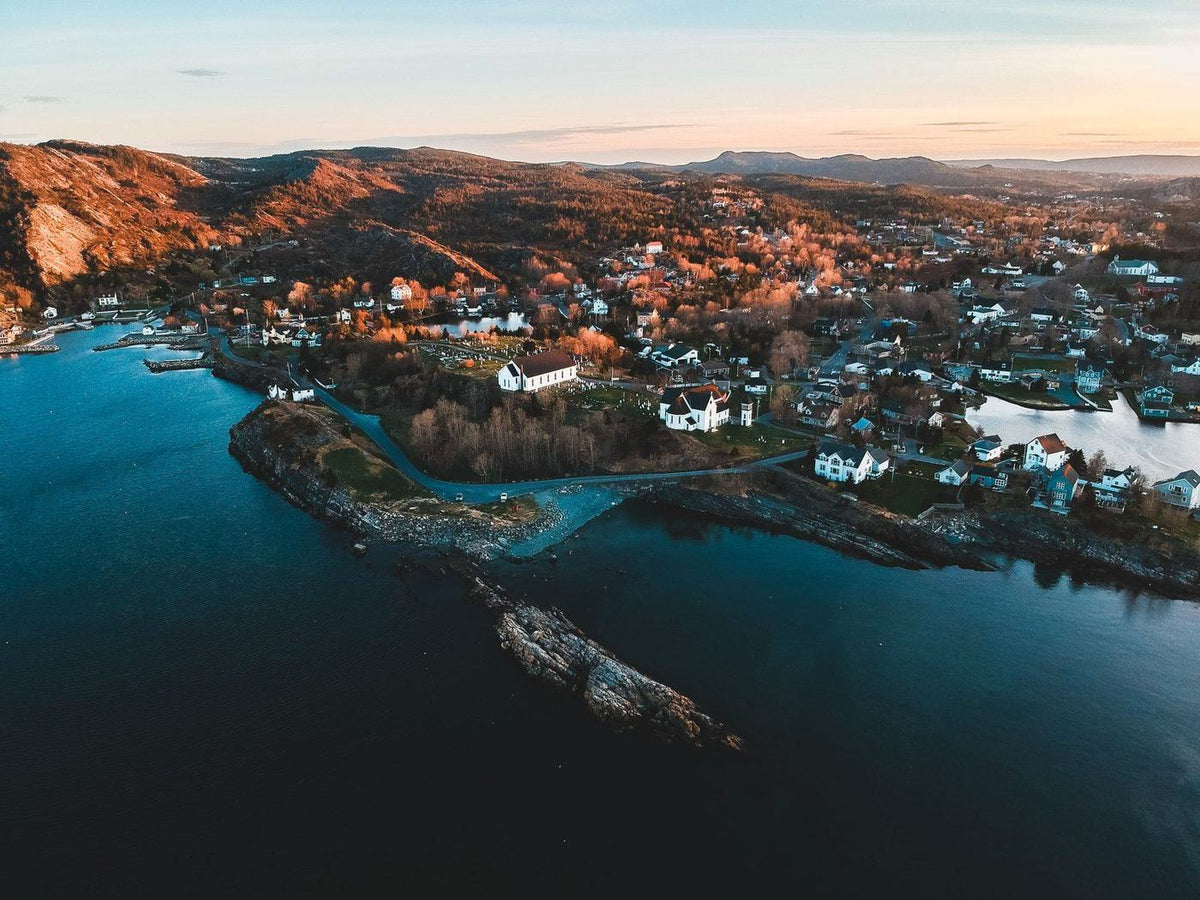
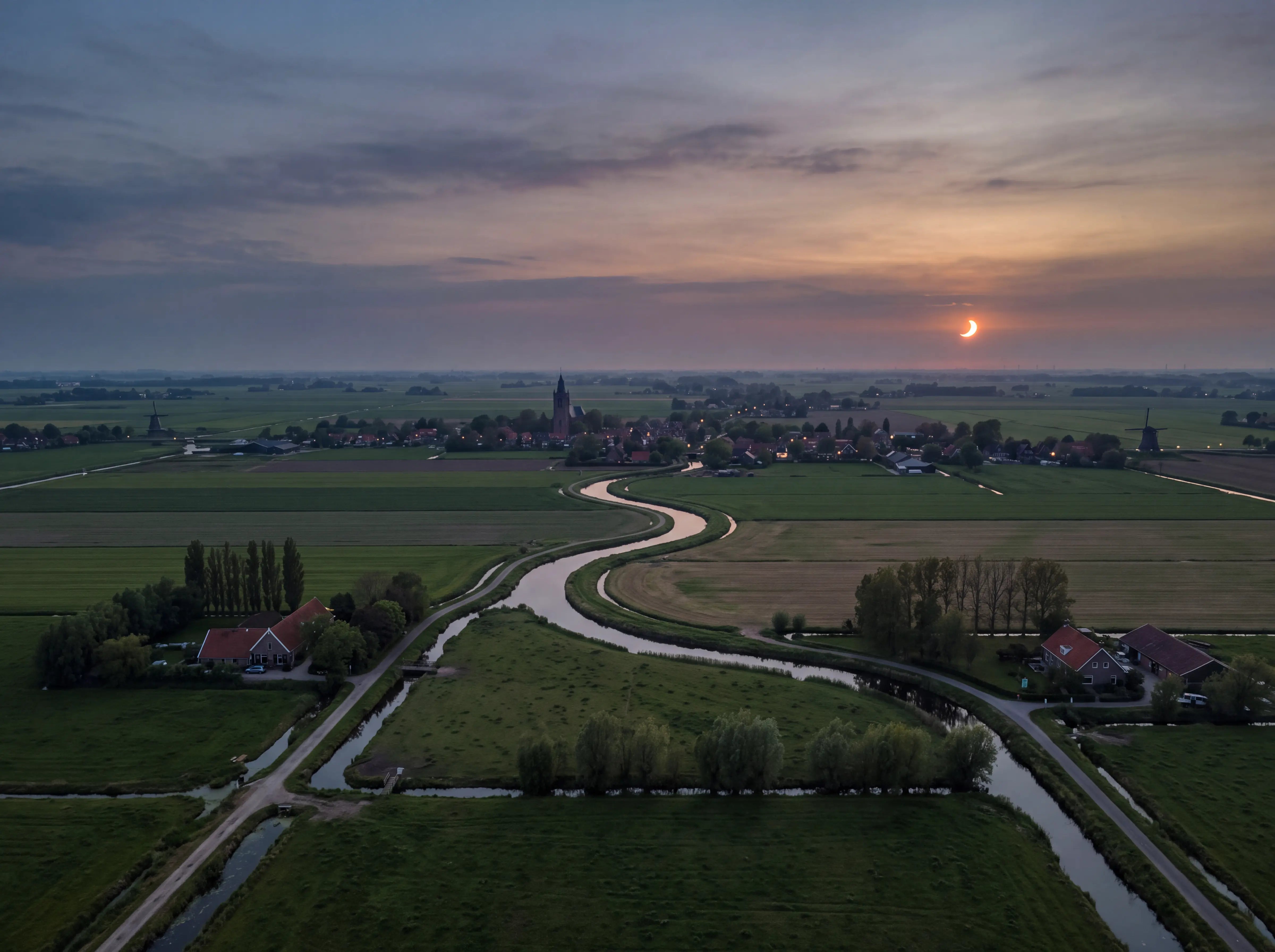
An eclipse is over faster than you think. Because you cannot fill the frame with the sun, the winning choice with a drone is almost always this: the landscape as the main subject, with that special light as the mood. Before you take off, decide which composition you want and fly straight to it. Think of a recognisable foreground (a church tower, a coastline, a river bend, a skyline) with the changing light moving across it.
Tip 4: Let the twilight do the work
This is the strongest eclipse drone shot there is. Around the maximum the light turns strange and silvery, as if someone is slowly turning down a dimmer. Fly low over a recognisable landscape and capture that unnatural mood. And because the sun is low and the light is fading, shadows become extremely long and soft: a top-down shot of trees, dunes or buildings shows off those shadows beautifully.
Tip 5: Check your drone camera settings
It gets dark fast, so you are working with fading light. Keep your ISO as low as possible (100 to 400) to limit noise, and rather let your shutter speed drop than push the ISO up. Shoot photos in RAW so you can correct that special twilight afterwards without losing quality. If you are shooting video, use an ND filter to meet the 180-degree rule and avoid stuttering footage. And focus on the landscape, not on the sun.
Tip 6: Make a timelapse or hyperlapse of the light
Not the sun but the changing light is your subject, and that lends itself perfectly to movement over time. Park your drone on a stable point (or use the timelapse/hyperlapse mode) and record how the landscape slowly darkens as the sun drops. Across much of Europe the light never really comes back: the eclipse runs straight into sunset. Do keep an eye on your battery and flight time: with a second battery at hand you will not miss the maximum. And keep the drone low and close, certainly as it gets darker.
Read the tips and guides for making a timelapse and hyperlapse via Drone Class Plus.
Tip 7: Capture the mood on the ground, not just the sky
The story of an eclipse is as much on the ground as it is in the air. Tell the moment without having to put the sun in frame. And stay up a little longer after the maximum: the eclipse runs into the sunset, and with a good ND filter you still bring home an atmospheric horizon. Our guide on the golden hour and blue hour will help you with that.

Frequently asked questions
Can you film a solar eclipse with a drone?
You can film the mood on the ground and the twilight just fine, but not the sun itself directly without a dedicated solar filter in front of the lens. Filming straight into the sun can permanently damage your drone’s image sensor. The best eclipse drone footage therefore shows the landscape, not the sun.
Does the sun damage my drone’s camera?
Yes, it can. Just as with your eyes, filming directly into the sun can cause burnt-out, permanently damaged pixels on the sensor. A normal ND filter does not protect against that well enough; you need a real solar filter. Safer still is simply not putting the sun in frame at all.
Am I allowed to fly during the solar eclipse of 12 August?
Yes, as long as you stick to the normal rules. The eclipse falls in the last hour before sunset, so make sure your drone carries lighting, keep it in sight (VLOS), and stay away from the crowds gathering at viewing spots. Always check the drone map for your country.
What time is the solar eclipse in Europe?
On 12 August 2026 the partial phase starts between roughly 17:00 and 17:40 UTC (19:00 to 19:40 CEST), with the maximum between roughly 17:50 and 18:40 UTC (19:50 to 20:40 CEST). Greatest eclipse worldwide is at 17:46 UTC. Across much of central, eastern and southern Europe the sun sets before the eclipse is over. Exact times differ by a few minutes per location.
What is the best thing to film during the eclipse?
The twilight on the landscape, the extremely long shadows and the mood on the ground. Those show what makes the moment special without you having to film the sun directly. Fly low over a recognisable landscape and capture the changing colours.
Do I need a drone licence to film this?
For every drone, starting from 250 grams, you need the EU Drone License (A1/A3), and you have to register as an operator. That applies on a special evening like this one too. Flying without a licence can earn you a fine.
Fly safely during the solar eclipse
An eclipse is exactly the kind of moment where knowing the rules and knowing your camera makes the difference between a unique shot and a damaged sensor or a fine. You get that knowledge with the EU Drone License: available online, usually within a day. Drone Class is recognised by RDW and EASA, with 75,000+ pilots who went before you, a 4.9 rating and 95% passing first time.
Want to take your photography to a higher level? In Drone Class Plus you learn exactly the kind of light and composition technique you need on an evening like this.