
Since 2024, most drones will be required to broadcast an operator number via Remote ID. This system makes drones remotely identifiable and plays an increasing role in the enforcement of drone rules. By 2026, the rules are further tightened and more actively enforced. In this blog, we explain exactly what Remote ID is, when it will be mandatory, how to set it up and what will change in 2026.
What is Remote ID?
Remote ID is a remote identification system. You can compare it to a digital license plate for your drone. While flying, the drone continuously transmits data via wifi or bluetooth, which can be captured by enforcement agencies with an app. The Remote-ID requirement is included in European drone rules.
While flying, the drone transmits data and its operator number, which can be captured by enforcement agencies with an app.

What data does Remote ID transmit?
Remote ID transmits the following information during flight:
- The drone pilot's operator number (your RDW registration number)
- The serial number of the drone
- The location of the controller or takeoff point
- The speed and direction of flight of the drone
Important: Remote ID never sends personal information such as the driver's name, address or phone number. Only enforcement agencies can find out who the pilot is through the operator number.
Not sure which license you need?
When is Remote ID mandatory?
Whether you must transmit Remote ID depends on your drone's Cx label and the category in which you are flying. Below is a complete overview.
|
Cx label |
Subcategory |
Remote ID |
|
C0 |
A1 |
Not required |
|
C1 |
A1 |
Required |
|
C2 |
A2 |
Required |
|
C2, C3, C4 . |
A3 |
Required |
Drones without Remote ID requirement:
- Drones without a Cx label* and homebrew in subcategory A3
- All drones under 250 grams* in subcategory A1
- Toy drones
* Released in the EU by the manufacturer before January 1, 2024.
How do I set up Remote ID on a drone?
Cx-label drones support Remote ID. You only need to enter the operator number in the settings. The drone automatically transmits Remote ID when you start flying.
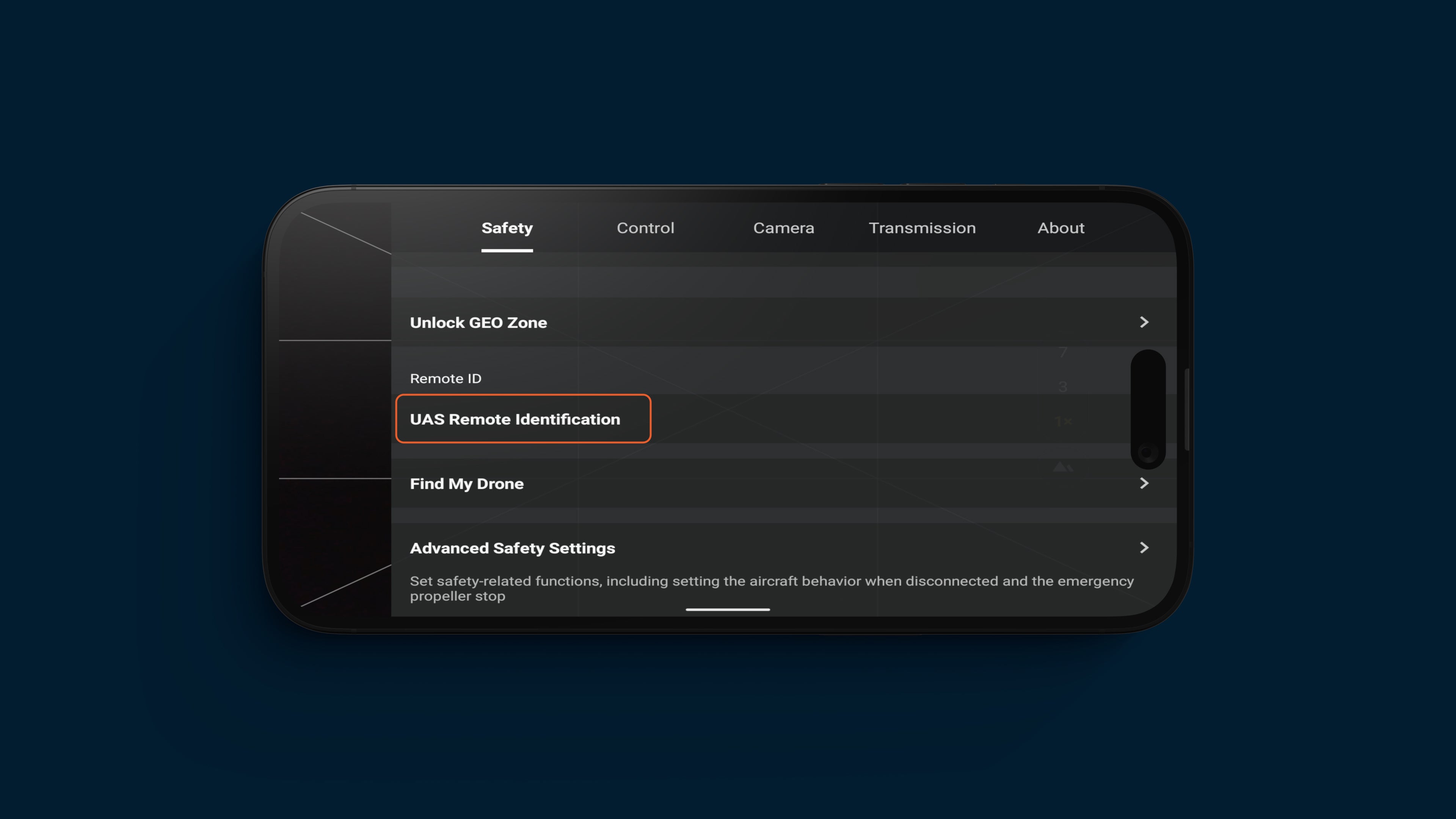
Through these steps, you can set your operator number on a DJI drone:
- Enable the remote controller
- Navigate to the settings menu, click on the three dots at the top right of the controller screen
- In the settings menu, go to ‘Safety’
- Scroll down to the ‘UAS Remote Identification’ option
- Open ‘UAS Remote Identification’ and enter your operator number in the input field
The operator number must be entered in full, including the last three digits.
Do I need Remote ID in the specific category?
If you are operating in the specific category, then the drone must always emit Remote ID. This is mandatory even for drones without a Cx label. However, many drones without a Cx label do not support broadcasting Remote ID. If your drone does not support this, you need to install a Remote ID addon on the drone. This external module will ensure that the operator number is broadcast.
What if my drone does not have built-in Remote ID?
Flying in the specific category with a drone without built-in Remote ID? Then you need to install an external Remote ID add-on module. This is a small device you attach to or on the drone that transmits the operator number.
Popular Remote ID add-on modules:
- Dronetag Beacon (Gen.2) - A compact module weighing only 16 grams with its own battery (up to 16 hours) and GPS receiver. Easy to attach with Velcro.
- Dronetag BS - A built-in module of only 3 grams, specially designed for FPV drones. Has its own GPS antenna and is smaller than a postage stamp.
- Dronetag DRI - The smallest module (1.5 grams), EASA compliant, starting at around €49.
A separate add-on module is also useful for those with multiple drones. You can move the module between devices.
What will change in 2026?
In 2026, there are a number of important developments around Remote ID:
More active enforcement. The police and ILT (Inspectorate for Environment and Transport) are increasingly checking whether drone pilots are broadcasting Remote ID. The 2024 temporary exemption has expired.
More Cx-labeled drones available. EASA has now officially approved 66 drones with a Cx label, 26 of which are from DJI. As a result, Remote ID is increasingly widespread.
Proposal: Remote ID starting at 100 grams. The European Commission is working on a Drone Security Package that aims to make Remote ID mandatory for all drones over 100 grams (now 250 grams). EASA is preparing a proposal, with approval expected in Q3 2026.
New no-fly zones and CTR changes.With the partial opening up of CTRs at airports, Remote ID becomes extra important for air traffic control.
What are the consequences if I fly without Remote ID?
Flying without Remote ID while it is mandatory is a violation of European drone regulations. The fines for drone violations in the Netherlands range from €250 to €8,700, depending on the severity and number of violations. The police and ILT are authorized to enforce this and will do so more actively in 2026 than before.
Frequently asked questions about Remote-ID
How do I receive an operator number?
Register yourself as an operator with the RDW. This is mandatory for all drones. After registration, you will receive an operator number that you can enter.
What is the difference between the operator number and Remote-ID?
The operator number must be physically affixed to the drone (sticker or plate). Remote-ID is the system that transmits the operator number on your drone.
Does my drone under 250 grams need Remote-ID?
In the open category not. Drones under 250 grams are exempt from the Remote ID requirement. You will need an operator number need, if your device has a camera.
Do I have to reset Remote ID every time?
No. You enter your operator number once through your drone's settings. After that, it is automatically broadcast with each flight.
All information about drone rules and certifications
In addition to the Remote ID and operator number, the EU Drone License is often required when flying a drone in the EU. At Drone Class, you can find information about drone rules and the training and examination for the EU Drone License.