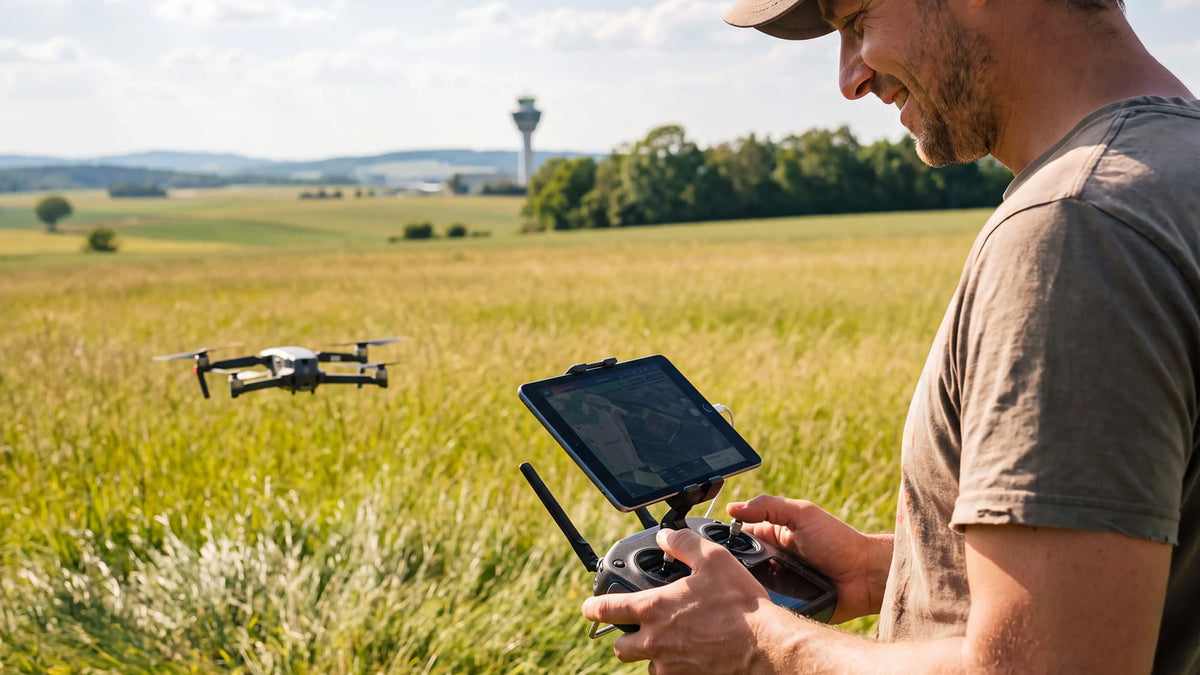
Since 6 August 2026, flying a drone in the controlled airspace around German airports has become considerably easier. For many flights in the outer parts of a control zone (CTR), you no longer need separate permission from air traffic control. Where almost every flight within a German CTR used to require permission, an automatic, general clearance now applies in the outer zones. In this guide, you'll read exactly what has changed, which altitudes apply, and where you still need to be careful.
What has changed?
The German air traffic control organisation DFS has revised the procedures for drones in CTRs. Until recently, you had to request permission for almost every flight within a CTR, which often meant long processing times and a lot of paperwork, especially for recurring inspections and surveys. The new regulation (NfL 2026-1-3960) replaces the old one and divides each CTR into four zones, each with its own altitude limit.
The four zones explained
Every German CTR is now divided into an inner area (zone 1) and an outer area (zones 2 to 4). Only in zone 1 do you still need permission.
|
Zone |
Location |
Maximum altitude |
|
1 |
Directly around the airport and the runways |
Permission always required |
|
2 |
Innermost part of the outer area |
25 m above airport or ground level (lowest counts) |
|
3 |
Middle part of the outer area |
45 m above airport or ground level (lowest counts) |
|
4 |
Remaining part of the CTR |
100 m above airport level or 50 m above ground (highest counts) |
In zones 2, 3 and 4 a general clearance applies: you can fly there without a separate request, provided you stay within the altitude limit of that zone and meet the other conditions. If you want to fly higher than the zone limit or fly in zone 1, you still need permission.
Vous ne savez pas quelle licence choisir ?
Drone inspections of tall objects
There is a special exception for professional work. If you're inspecting a tall object such as a wind turbine, a bridge, a mast or a building, you may exceed the regular altitude limit, as long as your drone stays within 30 metres horizontally and 15 metres vertically of the object. This makes façade, roof and turbine inspections in a CTR far more workable than before.
A central digital portal for requests
Alongside the new rules, Germany introduced a central digital portal. Via the DFS portal and the DIPUL map tool you can check whether permission is needed for your flight and, if so, submit it right away. This does away with the fragmented system in which every airport had its own procedure. Do bear in mind a processing time: handling an individual request usually takes around two weeks.

Which airports does this apply to?
The new procedures apply to the CTRs of the major German airports, including Berlin Brandenburg, Bremen, Cologne/Bonn, Dresden, Düsseldorf, Erfurt-Weimar, Frankfurt Main, Hamburg, Hanover, Leipzig/Halle, Munich, Münster/Osnabrück, Nuremberg, Saarbrücken and Stuttgart. Separate, dedicated arrangements apply to smaller airports and regional airfields. So always check the zone map of the specific airport where you want to fly.
What does this mean for drone pilots?
If you fly in Germany with a Dutch EU Drone Certificate, nothing changes about your paperwork: that certificate remains valid. What does change is that you have more legal options close to German airports than before, without having to submit a request every time. For anyone flying in the German border region or carrying out professional inspections, this is good news. Two things remain just as important:
• Valid registration. This means you hold a valid EU Drone Certificate and have registered yourself as an operator. You must be able to show the EU Drone Certificate in case of an inspection. The operator number must be attached to the drone and, in some cases, broadcast via Remote ID
• Check the map for each flight. Use the DIPUL map tool and the airport's zone map. Zones and altitudes vary by location, and the federal states may have additional rules, for example about flight times near residential areas.
Frequently asked questions
What has changed about the drone rules in Germany since August 2026?
Since 6 August 2026, every German CTR has been divided into four zones. In the outer zones (2 to 4), an automatic, general clearance applies, so you can fly there without separate permission within the altitude limit. Only in zone 1, directly around the airport, is individual permission still required.
How high can I fly in a German CTR?
That depends on the zone: 25 metres in zone 2, 45 metres in zone 3, and up to 100 metres (above airport level) or 50 metres above the ground in zone 4.
Is my Dutch EU Drone Certificate valid in Germany?
Yes. The EU Drone Certificate is valid in all EU countries, so also in Germany.
Can I now fly anywhere around German airports?
No. In zone 1, directly around the airport and the runways, permission remains mandatory. In the outer zones you can fly under the general clearance, but only within the altitude limit and the conditions. You also remain responsible yourself for giving way to manned aviation.
Where do I request permission if I do need it?
Via the central digital portal of the DFS and the DIPUL map tool. There you check whether you need permission and, if so, submit it directly. Allow for a processing time of about two weeks for a request.
When does the obstacle exception apply?
If you're inspecting a tall object (wind turbine, bridge, mast, building) you may exceed the zone limit, as long as you stay within 30 metres horizontally and 15 metres vertically of the object. This is mainly relevant for professional inspection flights.
Well prepared to cross the border
The new German rules give you more room, but they also require you to know exactly which zone you're in and which altitude applies there. That knowledge starts with a solid foundation. With the EU Drone License you fly legally across all of Europe, including Germany. Drone Class is recognised by RDW and EASA, 75,000+ pilots have gone before you with a 4.9 out of 3,300+ reviews, and 95% pass on the first try.